
What Independence Actually Looks Like at Home
June 1, 2026 · Practical Life
When people hear that Montessori supports independence, I think they sometimes picture a very specific child.
This child wakes up peacefully.
Gets dressed.
Prepares breakfast.
Washes the plate.
Packs a small bag.
Checks the weather.
Makes a responsible footwear decision.
Then they turn to the adult and say:
"Please enjoy your morning. I have everything under control."
This child does not live in my classroom.
And I am guessing they do not live in your house either.
Independence in childhood is much less polished.
Sometimes independence looks like a child putting on one sock and then lying on the floor because the second sock has become emotionally impossible.
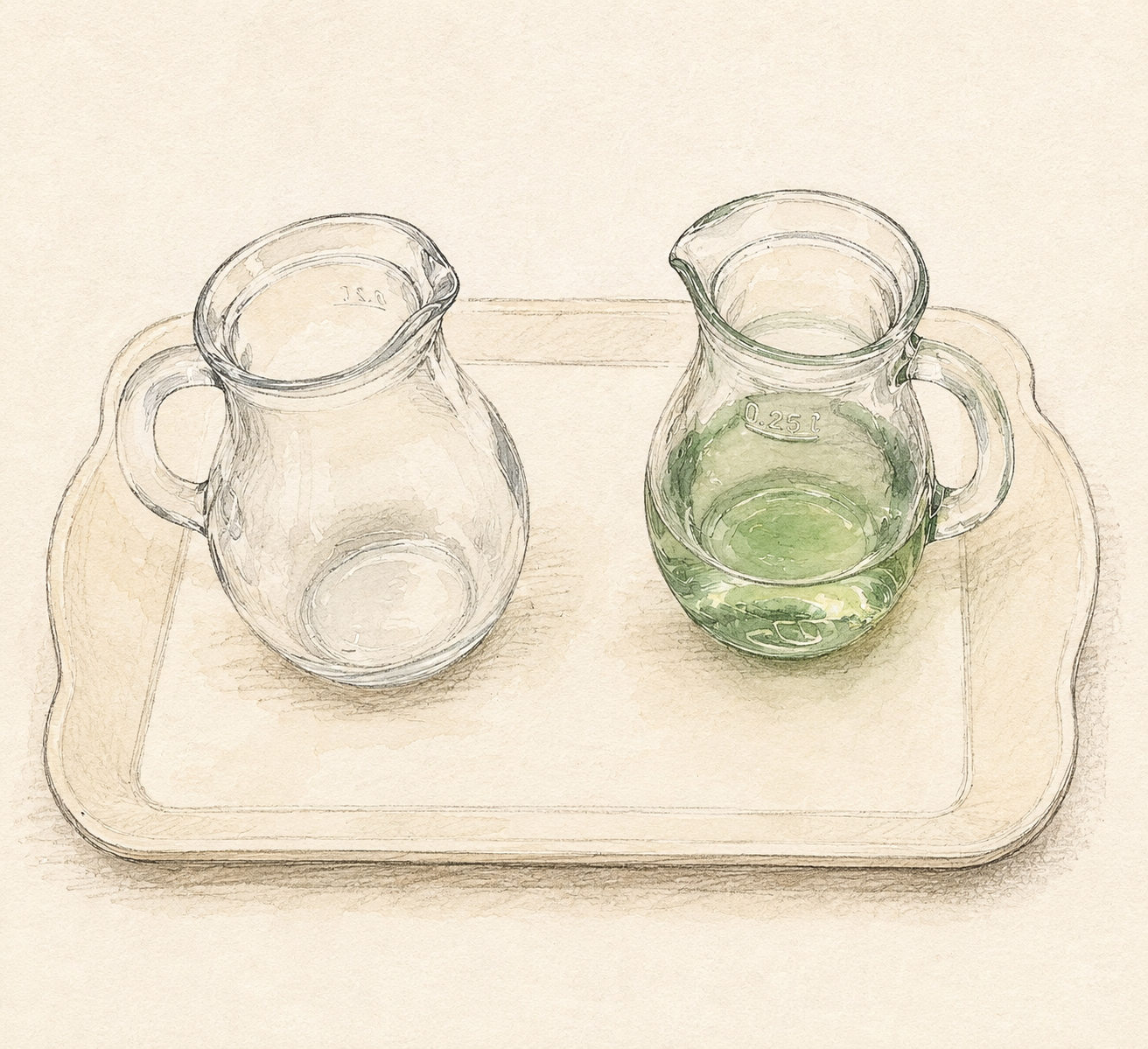
Sometimes it looks like pouring water successfully three days in a row and then, on Thursday, pouring the entire pitcher onto the table.
Sometimes the child says:
"I DO IT."
Then forty-five seconds later:
"HELP ME."
This is development.
Montessori independence is not about expecting children to function like tiny adults.
It is about giving children meaningful opportunities to participate in their own lives.
That is a very different thing.
Independence Does Not Mean Doing Everything Alone
I want to start here because I think this is one of the biggest misunderstandings.
An independent child is not a child who never needs anyone.
Actually, being able to recognize when you need help is an important form of independence.
Think about adults.
I consider myself an independent person.
There are still things I cannot do.
There are things I should not do.
There are things I could probably figure out after seventeen hours and a minor emotional breakdown, but asking someone with experience would be much more reasonable.
Children are the same.
Independence is not:
You do it yourself no matter what.
It is developing the skills, confidence, awareness, and opportunities to participate more fully.
Sometimes the child does the entire task.
Sometimes they do one part.
Sometimes you begin and they finish.
Sometimes they try and ask for help.
The goal is not to remove the adult.
The goal is to be thoughtful about how much of the child's work we are doing for them.
There is a difference.
Adults Are Extremely Efficient
This is part of the problem.
We are fast.
A child is trying to put on a jacket.
I can put the jacket on in approximately three seconds.
The child may require seven minutes, two unusual body positions, and a short argument with one sleeve.
The adult watches.
We look at the clock.
We look at the child.
We look at the clock again.
"Here. Let me do it."
Done.
And sometimes we genuinely need to do that.
There are mornings when you have to leave.
The dentist is not interested in your beautiful commitment to Practical Life while you arrive thirty-five minutes late.
Real life exists.
But when the adult always chooses efficiency, the child loses opportunities to practice.
The child does not become faster at putting on their coat by watching me become extremely good at putting on their coat.
At some point, their hands need to do the work.
This is one of the most uncomfortable parts of supporting independence.
You have to tolerate inefficiency.
You have to watch a process that you could complete much faster.
Sometimes you have to leave a little more time.
Sometimes you have to resist correcting every movement.
Sometimes you have to watch the child put their shirt on backward and ask yourself:
Is anyone in danger?
No?
Okay.
Maybe we continue.
Look at What You Do for Your Child Every Day
One of the simplest things I ask parents to do is notice.
Do not change anything yet.
Just notice.
What do you automatically do for your child?
You pour the water. Carry the backpack. Open the snack. Put the shoes away. Choose the clothes. Throw away the tissue. Get the spoon. Push in the chair. Clean the spill. Zip the jacket.
Some of these things may absolutely require adult help.
But probably not all of them.
Our routines become automatic.
A child hands us something and our hand reaches out before we have even thought about it.
They spill. We grab the towel.
They cannot open something immediately. We open it.
They drop something. We pick it up.
We are helpful.
Very, very helpful.
Sometimes too helpful.
Montessori has made me think carefully about unnecessary help because help can quietly communicate something to a child.
You need me to do this.
Again and again.
Even when the adult never says those words.
This does not mean you stand beside a crying child holding a sealed yogurt and say:
"Independence."
Please help the child.
It means we begin noticing where the child could participate.
That is the first step.
Start With Participation, Not Perfection
Parents sometimes ask me what their child should be doing independently at home.
I understand the question.
But I think we become too focused on the finished task.
Can they dress independently? Can they prepare food independently? Can they clean independently?
Maybe. Maybe not yet.
Instead, ask:
How can my child participate?
A two-year-old may not prepare an entire meal.
They can carry napkins to the table.
A three-year-old may not safely wash every dish.
They can carry their plate to a designated place.
A child may not be able to fully dress themselves yet.
They can push their arms through the sleeves. They can choose between two shirts. They can pull up their pants. They can try the zipper.
Participation is how independence develops.
We do not need to wait until a child can complete an entire adult task before inviting them into the process.
Actually, if we wait that long, we may be waiting forever.
Children become capable through experience.
The experience comes first.
The skill develops inside it.
Your Environment Might Be Saying "No" All Day
I think this is one of the biggest things families can take from Montessori.
Look at your home from the child's physical perspective.
Not emotionally. Literally.
Get lower.
What can the child reach? Can they access their cup? Can they reach a towel? Where do their shoes go? Can they hang up their coat? Can they reach the sink safely? Can they get a snack that they are allowed to have? Can they find the tools they need to clean a small spill?
Sometimes adults are frustrated that children are not independent in an environment designed entirely for adult bodies.
The hook is six feet high. The cups are in an upper cabinet. The sink is inaccessible. The cleaning cloths are hidden. The shoes apparently live in seven different places.
Then we say:
"Why don't you do anything yourself?"
How?
The environment matters.
A prepared environment at home does not mean renovating your kitchen so it looks like a Montessori school.
You do not need to replace every cabinet.
You do not need twelve identical baskets.
Please do not send me your renovation invoice.
Sometimes the change is simple.
A low hook. A small basket for shoes. A reachable drawer. A sturdy stool. A small pitcher. A cloth in a predictable location.
Independence becomes easier when the environment communicates:
You are allowed to participate here.
Give Things a Clear Place
Children benefit from knowing where things belong.
Honestly, adults do too.
I lose my keys when my environment becomes too creative.
At home, independence becomes much harder when the child has to ask an adult where every object lives.
"Where are my shoes?"
"Where is my cup?"
"Where does this go?"
"I don't know where the towel is."
If an object has a clear, consistent place, the child can begin to act without waiting for adult direction.
This is why order matters.
Not because your home needs to look perfect.
A home with children will look lived in.
Sometimes aggressively lived in.
The goal is predictability.
The child's coat goes here. Shoes go here. The child's dishes are here. Dirty clothes go here. Cleaning cloths are here.
When something has a place, the child has information.
We often say children need to be responsible, but responsibility is easier when the environment is understandable.
If I changed the location of your toothbrush every morning and then became frustrated that you could not independently brush your teeth, you would have some questions for me.
Children deserve the same consideration.
Let the Child Experience the Whole Process
A child spills water.
The adult sees the spill.
The adult cleans it.
The child continues with their life.
From the adult's perspective, the problem is solved.
From a Montessori perspective, part of the process may be missing.
The spill happened. What happens after a spill?
We wipe it.
This is not a punishment.
The child is not bad because water left the cup.
Water does that sometimes. Very unpredictable.
The cleanup is simply part of the activity.
This is why having an accessible cloth or sponge can be so useful.
"The water spilled. The cloth is here."
Maybe the child needs help.
Maybe the spill is enormous and you are now questioning why the small pitcher contained the Atlantic Ocean.
You can clean together.
The point is not that a three-year-old must independently restore the kitchen to professional standards.
The point is that the child experiences the complete sequence.
Pour. Spill. Notice. Wipe. Continue.
This happens with other tasks too.
We do not only invite the child to bake the exciting part and then send them away when there is flour on every visible surface.
We show that cleanup belongs to the process.
We do not only let the child choose clothes. They can begin learning where dirty clothes go.
We do not only invite children to take materials out. They learn how things are restored.
Independence includes understanding that our actions have beginnings, middles, and ends.
Slow Down When You Show Them
Sometimes parents tell me:
"I've shown him how to do it a hundred times."
Then I watch the adult show the task.
It happens at the speed of light.
"Okay, you take this, turn this, pull it, push this down, and then put it here. See?"
No.
I did not see.
And I am an adult.
Children need clear information.
When you show a child how to do something, slow down.
Use fewer words.
Let your hands show.
Think about what the child actually needs to notice.
If you are showing a child how to wipe a table, you do not need to give a full speech about household sanitation.
Show the cloth. Show the movement. Show where the cloth goes when you are done.
Then allow the child to try.
This is something Montessori training made me much more aware of.
Adults talk constantly.
We talk through every movement.
"Now I'm picking this up, and then I'm putting it here, and be careful because you don't want to spill, and remember last time—"
Sometimes our hands could give clearer information if our mouths took a small break.
A loving break.
But a break.
Give Fewer Instructions
This connects to independence more than people realize.
Imagine I say:
"Go upstairs, get your pajamas, put your dirty clothes in the hamper, brush your teeth, use the bathroom, and then pick a book."
That is one sentence to me.
To a young child, I may have just assigned a small corporate project.
Then I become frustrated.
"Why are you playing with a sock?"
Honestly, the child may have forgotten everything after "upstairs."
Supporting independence sometimes means simplifying the information.
"Put your dirty clothes in the hamper."
Pause.
Then the next step.
As routines become familiar, the child may be able to manage a longer sequence.
But we cannot confuse giving directions with teaching independence.
If the child requires me to narrate every single next step every night, they are still relying on my brain to organize the process.
Sometimes a visual routine helps.
Sometimes objects can be arranged in a logical sequence.
Sometimes we repeat the same order consistently.
The question is:
How can the child gradually hold more of the process themselves?
That is different from simply becoming better at following a long list of adult commands.
Choice Can Support Independence
Children hear a lot of instructions.
Wake up. Get dressed. Come here. Sit down. Eat. Stop. Wait. Go.
We control a lot of their day.
Some of that is necessary.
A two-year-old cannot independently decide whether the family pays the electric bill this month.
Adults have responsibilities.
But we can look for places where real choices are possible.
"Would you like the blue shirt or the green shirt?"
"Would you like to carry the napkins or the cups?"
"Do you want to brush your teeth before or after pajamas?"
"You may choose an apple or a banana."
The choice is real.
Both options work for the adult.
This matters.
Please do not ask:
"Would you like to leave the playground?"
When "no" is not actually an available answer.
The child says no.
Now everyone is upset.
You knew. The child knew. We all knew.
A limit may be clearer.
"It is time to leave. Would you like to walk to the car or hold my hand?"
That is freedom within limits.
The child has agency.
The adult is still holding the necessary boundary.
Independence develops when children have meaningful opportunities to make decisions and experience those decisions.
Not unlimited control.
Real participation.
Do Not Ask a Question When You Mean an Instruction
I learned this through children.
Children are very helpful in exposing unclear adult communication.
"Can you put your shoes on?"
"No."
Interesting.
Technically, the child answered the question.
Sometimes we ask questions because we are trying to sound polite.
"Can you clean that up?"
"Do you want to get dressed?"
"Are you ready to go?"
Then the child responds honestly.
No.
If something is not optional, we can say it clearly.
"It is time to put on your shoes."
Then we can offer a choice where one exists.
"Would you like to sit on the chair or the floor while you put them on?"
Clear limits actually help children act more independently because the child is not constantly trying to decode whether the adult is suggesting, requesting, negotiating, or deciding.
Sometimes the adult does not know either.
We are all discovering the boundary together.
The child asks for a fourth snack.
"No. Well, maybe. Did you eat lunch? Okay, just one. Actually, no. Fine."
Now the environment is a legal negotiation.
Clarity helps.
Independence Requires Real Time
This is not always the advice parents want.
You need time.
Not endless time. Not a three-hour dressing period.
But independence is very difficult to practice when every routine begins five minutes later than it should.
We wake up late.
We rush.
"Get dressed."
The child tries.
"Faster."
They struggle.
"Here, I'll do it."
Then we leave.
The next morning?
Same thing.
The child is not failing to become independent.
The child is not being given enough consistent opportunity to practice.
If there is one routine you want your child to take more ownership of, create time around that routine when possible.
Maybe independence does not need to happen during the most stressful ten minutes of your morning.
Practice putting on shoes when you are not leaving.
Invite your child to pour water at lunch on a quiet Saturday instead of introducing the pitcher for the first time three minutes before school.
Let them help pack a bag the night before.
We can prepare for independence.
Sometimes adults unintentionally make the first practice happen during a crisis.
Then we decide:
"They can't do it."
Maybe they cannot do it yet.
Or maybe no one performs their best while another person is saying:
"WE HAVE TO GO."
Expect Spills, Mistakes, and Very Strange Decisions
If you give a child independence, they will not always do what you would do.
This is important.
A child may choose clothes that do not match.
They may place something in a slightly unusual spot.
They may fold a towel in a shape that cannot legally be called folded.
They may pour too much water.
They may use an unreasonable amount of soap.
They may put on socks inside out and insist everything is perfect.
The adult has to decide what actually matters.
Is the child safe? Is another person being harmed? Is the environment being damaged? Is there a clear reason the task needs to be done differently?
Or is the child's method simply not my preferred method?
Those are different.
Sometimes we say we want independent children, but what we actually want is children who independently make the exact decision we would have made.
That is a very specific form of independence.
Convenient independence.
Real independence comes with judgment.
And judgment develops through experience.
A child pours too much water.
Now the glass is difficult to carry.
That is information.
A child chooses not to wear a jacket on a cool morning.
Depending on the weather and the child's age, maybe you bring the jacket.
The child notices the temperature.
Information.
Natural consequences can teach without the adult needing to turn every mistake into a speech.
Sometimes the experience already explained itself.
We can be quiet.
Difficult. But possible.
"I Can Do It Myself" Does Not Mean the Child Is Ready to Do Everything
There is a beautiful stage when a child becomes deeply committed to independence.
"I do it."
Excellent.
The child has decided they are personally responsible for every task in the known universe.
They want to cut. Pour. Carry. Climb. Open. Close. Push.
Use the very sharp adult tool you are currently holding.
"I DO IT."
The desire for independence may be ahead of the child's current ability.
That does not mean we shut down the desire.
It means the adult prepares.
Maybe the child cannot use this knife. Is there an appropriate tool they can use?
Maybe they cannot pour from a full gallon container. Can I provide a smaller pitcher?
Maybe they cannot safely carry the large ceramic plate. Can they carry their cup?
This is where preparation matters.
The child's desire is saying:
Let me participate.
The adult has to interpret that desire responsibly.
We do not say yes to everything.
We create appropriate ways for the child to act.
That takes more thought than simply saying:
"You're too little."
Sometimes the child is too little for the exact task.
They may not be too little for any involvement.
Stop Redoing Everything in Front of Them
Parents, I say this gently.
The child makes the bed.
You look at it.
Interesting.
The blanket is sideways. One stuffed animal is under the pillow. There is a mysterious lump in the middle.
The child leaves.
You immediately remake the entire bed.
The child sees you.
What did they learn?
Maybe:
My version was wrong.
Or:
Someone else will do it correctly after me.
Or:
Why bother?
This does not mean you live forever with every task completed imperfectly.
There are hygiene concerns. Safety concerns. There are times a job genuinely needs to be completed to a particular standard.
But sometimes we need to tolerate the child's current level of ability.
You can teach. You can show again another day.
You can say:
"I see the towel is still wet. It needs to hang open so it can dry."
That information is connected to the task.
What I try to avoid is silently correcting everything simply because the child's work does not look like adult work.
Of course it does not.
They are practicing.
Imagine learning to cook while a chef follows behind you and remakes every dish without explanation.
Eventually, you might stop cooking.
Or fight the chef.
Depending on your personality.
Independence Is Not About Withdrawing Connection
I want to be very clear about this.
Supporting independence is not the same as becoming unavailable.
A child says:
"Help me."
The Montessori response is not automatically:
"No. You are independent."
That would be very strange.
We observe.
What does the child need?
Maybe they truly need help. Maybe they need help beginning. Maybe they need reassurance. Maybe they know how to do the task but are tired. Maybe they are asking for connection.
Children are not machines completing Practical Life sequences.
Their emotional needs matter.
Sometimes I help a child with something I know they can do.
Context matters.
The child may have had a difficult morning. They may be overwhelmed. They may need the experience of being cared for.
The goal of independence is not to make a child feel alone.
Secure relationships can give children the confidence to move outward.
The child knows:
I can try.
And:
Help is available when I genuinely need it.
Those ideas can exist together.
Actually, I think they should.
"Help Me to Do It Myself"
This is one of the ideas most closely associated with Montessori for a reason.
Help me. To do it. Myself.
All three parts matter.
The child may need preparation. A presentation. An appropriate tool. A slower pace. A clear environment. A reminder. A small amount of assistance.
We are helping.
But we are helping toward the child's participation.
Imagine a child struggling with a zipper.
I could zip it.
Task complete.
Or I might hold the bottom of the jacket steady while the child pulls.
Now I am helping.
The child's hand is still doing part of the work.
Later, maybe I show how the zipper connects.
Later still, the child manages the entire process.
Support can change as ability changes.
This is what adults sometimes miss.
We continue giving the same level of help because it became our routine.
The child was two. They needed help.
Now they are three. I still do it.
Now four. Still me.
At some point, I have to observe again.
What can the child do now that they could not do six months ago?
Children change.
Our help should be able to change too.
Sometimes Independence Looks Like Asking for Help
I keep coming back to this because it matters so much.
A child tries.
They recognize the task is beyond their current ability.
They come to you.
"Can you help me?"
That can be independence.
The child assessed the situation. They communicated a need. They sought an appropriate resource.
Honestly, some adults are still working on this skill.
Independence is not stubbornly struggling forever because asking for help feels like failure.
I want children to develop confidence in their abilities.
I also want them to understand that humans live in communities.
We help each other.
Sometimes I know something you do not. Sometimes you know something I do not. Sometimes we carry something together.
Montessori independence is deeply connected to community.
The child learns to care for themselves. Then their environment. Then, in so many ways, other people.
Independence and interdependence are not opposites.
A child who can participate meaningfully has more ways to contribute.
What Does Independence Actually Look Like?
It may look small.
Your child gets their own cup.
They carry their plate to the table.
They try to button one button.
They wipe a spill.
They choose between two shirts.
They put dirty clothes in a basket.
They peel a banana.
They wash part of a vegetable.
They tell you:
"I can't open this."
They wait while you show them.
They try again.
Maybe tomorrow you still put on their shoes.
Maybe they are not ready to pour water without help.
Maybe dressing takes a long time.
The goal is not to check every independence skill off a list before kindergarten.
The goal is to notice where the child can participate today.
Then prepare for a little more tomorrow.
Not because we are trying to rush children into adulthood.
The world will do enough rushing.
We support independence because children are building a relationship with themselves.
I can try. My movements have an effect. I can care for things. I can make choices. I can solve some problems. I can ask for help. I belong here.
That last one matters to me.
Because when a child can participate in the life of a home, the home is not simply a place where adults do things around them.
The child becomes part of the community.
They carry. Prepare. Clean. Choose. Help. Try. Make mistakes. Try again.
My Honest Take on Independence at Home
I think adults sometimes put a lot of pressure on themselves to create a "Montessori home."
You see a beautiful space online. There is a tiny sink. A perfectly organized dressing area. Every wooden object appears to have been placed by a museum curator.
Then you look at your own house.
There is a shoe in the kitchen.
No one knows why.
Please breathe.
Montessori at home does not begin with buying everything.
It begins with looking at the child and the environment.
What is my child trying to do? Where do they constantly ask for help? What do I do automatically for them? Is there a small change that would allow more participation? Can they reach it? Can they carry it? Do they know where it belongs? Have I shown them slowly? Am I giving them time to practice? Am I expecting perfection?
Those questions are free.
Very unhelpful for Montessori product marketing.
But free.
Maybe you move the cups. Maybe you add a low hook. Maybe you stop carrying the child's backpack from the car every afternoon. Maybe you show them where the cloth is. Maybe you begin putting dirty clothes in the same basket every day.
Small changes.
Then observe.
The child may surprise you.
They may also spill something.
Probably both.
Independence is messy because development is messy.
It is not a photograph of a perfectly prepared snack station.
It is the child standing at the snack station, very seriously trying to spread something on bread while you quietly resist the urge to take the knife.
It is the child saying, "I do it," and giving them space to try.
It is knowing when to wait.
Knowing when to help.
And being willing to change the amount of help as the child changes.
The question I keep asking myself is simple:
Am I doing something for this child that they are ready to begin doing with me, or for themselves?
Sometimes the answer is no.
The child needs me. So I help.
Sometimes the answer makes my hands very uncomfortable.
Because I realize I need to step back.
And wait.
The child may take longer. They may do it differently. They may need another try.
That is okay.
We are not raising efficient three-year-olds.
We are supporting developing human beings.
And independence does not happen the day we finally let go.
It develops in all the small moments when the child realizes:
I have a place in my own life.